
Scott County Probate Venue
Probate matters in Scott County are filed through the Scott County Clerk and heard in the Scott Circuit Court / Superior Court trial-court system. No separate Scott County Probate Court page was located in the official county sources. That matters for search strategy: use Indiana trial-court case search for public estate and guardianship case information, then contact the Clerk when a copy or certification is needed.
The local fee list confirms the venue. The Clerk publishes an Estates category and a Guardianship category, both tied to court filing fees. Probate records can include estate petitions, wills when filed, appointment orders, creditor notices, inventories, claims, accountings, distribution papers, guardianship petitions, care-related orders, and closing entries. Some of those documents may be public. Others may be restricted because they contain personal identifiers, medical facts, protected-person details, or minor-child information.
For older probate files, MyCase may show less than the Clerk can locate from the local file. The research did not find a separate county archive portal or a separate probate counter, so the Clerk remains the fallback for older estate files, non-digitized documents, and certified copies. Use the full cause number when available because the same surname may appear in several estate, guardianship, family, or civil matters.
Indiana family and guardianship statutes are visible in the Indiana Code Title 31 source assigned to Scott County probate records.
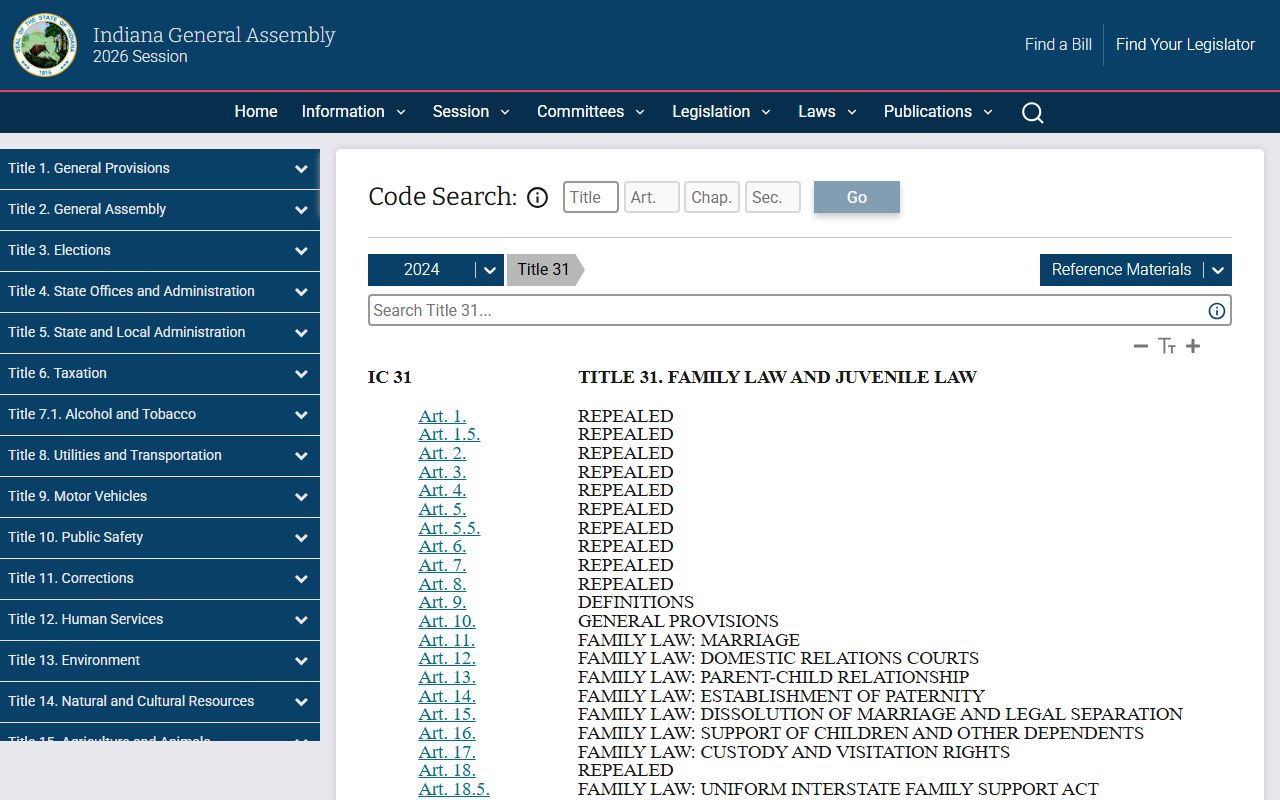
The statute source supports the need to treat guardianship and child-related probate records with more care than routine public case entries.
Scott County Probate Terms
Probate records use role names that are easy to confuse with civil or family case labels. The terms below help separate estate records from guardianship records before a Clerk request is made.
- Testator
- A person who made a will before death.
- Executor
- A person named in a will to carry out estate duties, often called a personal representative in court filings.
- Intestate
- Dying without a valid will, which changes how estate property is handled under state law.
- Guardianship
- A case asking the court to appoint a person to make decisions for a minor or incapacitated adult.
- Conservatorship
- A related protective term used in some jurisdictions for financial management; Scott County research points to guardianship as the local fee category.
Search Scott County Probate Cases
Public probate case lookup uses Indiana MyCase when the estate or guardianship is indexed and not confidential. Search by case number if known. If the case number is unknown, search by decedent name, protected person name, guardian name, personal representative name, or other party name, then narrow results to Scott County. MyCase may show the public case caption, court, case type, filing date, parties, CCS entries, hearings, orders, and financial entries where public.
| Search field | Type | How to use it |
|---|---|---|
| Case Number | Text | Use the estate or guardianship cause number when available. |
| Name | Text | Search decedent, protected person, guardian, personal representative, or party name. |
| County | Dropdown | Select Scott to avoid results from other Indiana counties. |
| Case Type | Dropdown | Use estate, unsupervised estate, guardianship, or miscellaneous if shown. |
| Filed Date Range | Date | Use for older probate searches or common names. |
| Search | Button | Runs the query in the public case system. |
If the document itself is not linked, the Indiana Judicial Branch public-records page points users to the clerk in the county where the case is heard. In Scott County, that is the Clerk's Office in Suite 120.
When the search involves a will, remember that a will is not always a stand-alone public record before it is filed in an estate case. The public search path is strongest after an estate case opens and the will, appointment, notices, claims, or orders become part of the court file. If no estate case appears, the Clerk can explain whether a local filing exists or whether the requested document is outside the court-record system.
Scott County Probate Contacts
Because probate is a trial-court case category rather than a separate local probate court, the useful contacts are the two local trial courts and the Clerk. The Clerk is the copy and filing counter. The court assigned to the case controls hearings and orders.
Scott Circuit Court
Judge: Jason M. Mount
1 E McClain Avenue, Suite 212
Scottsburg, IN 47170
812-752-8430
Mon-Thu 8:00 am-4:15 pm; Wed 8:00 am-noon; Fri 8:00 am-4:15 pm
Scott Superior Court
Judge: Marsha Owens Howser
1 E McClain Avenue, Suite 252
Scottsburg, IN 47170
812-752-8424
Mon-Tue 8:00 am-4:15 pm; Wed 8:00 am-noon; Thu-Fri 8:00 am-4:15 pm
Scott County Clerk
Clerk: Michelle Shelton
1 E McClain Avenue, Suite 120
Scottsburg, IN 47170
812-752-8420
Monday-Friday 8:30 am-4:30 pm
Scott County Probate Fees
The Clerk's fee schedule is the local source for probate filing and copy costs. Estate and guardianship filings have their own amounts. Certified copies use the same copy pricing as other court records. The Clerk page also states that personal checks are not accepted.
| Probate item | Amount | Scott County note |
|---|---|---|
| Estates (ES/EU) | $177 | Published Clerk filing fee for estate categories. |
| Guardianship (GU) | $177 | Published Clerk filing fee for guardianship category. |
| Plain copies | $1 per page | For court-file copies available through the Clerk. |
| Certification | $2 per certification | Added when a certified probate record is needed. |
| Chronological Case Summary | $1 per page | Useful when a full probate docket history is needed. |
Note: Older probate files or documents not linked in MyCase may still require a Clerk copy request.
What Scott County Probate Records Show
Estate records may show the petition or application, will if filed, order admitting the will, appointment of a personal representative, bond if required, creditor notices, claims, accountings, distributions, and closing entries. Guardianship records may show the petition, appointment order, bond, inventory, reports, accountings, care plans, and termination or closing filings. The public CCS can help trace each event even when the document image is not posted.
Scott County probate records should not be confused with federal bankruptcy records. Estate and guardianship cases are local Indiana trial-court matters. Bankruptcy is a federal debt proceeding in the U.S. Bankruptcy Court for the Southern District of Indiana, and its records use federal systems rather than the Scott County Clerk.
The assigned federal bankruptcy source is the U.S. Bankruptcy Court for the Southern District of Indiana.
That federal source is useful mainly to separate bankruptcy records from Scott County probate estate and guardianship files.
Scott County Probate Case Flow
Probate work follows a case path, not a one-time certificate request. The exact steps depend on whether the matter is an estate, unsupervised estate, guardianship, or related filing, but the local routing stays the same: Clerk filing, trial-court review, public CCS tracking where allowed, and Clerk copies when needed.
- Identify the case type, such as estate, unsupervised estate, guardianship, or miscellaneous probate-related matter.
- File through Indiana e-filing or the Clerk process when paper filing is allowed.
- Pay the Clerk filing fee or address any fee-waiver issue through the court process.
- Watch the public CCS in MyCase for filing events, notices, orders, and hearing settings.
- Request certified copies from the Clerk when an order, appointment, or closing document must be used outside the court file.
For federal bankruptcy records, the PACER court lookup source is PACER for the Southern District of Indiana Bankruptcy Court.
PACER does not replace the Scott County probate search path, but it is the correct federal lookup channel when the issue is bankruptcy rather than an Indiana probate case.
Restricted Scott County Probate Records
Not every probate-related document is fully public. Guardianship records may include medical evidence, protected-person information, reports, financial account details, or minor-child information. Indiana court access rules also exclude Social Security numbers, financial account numbers, and other protected identifiers. MyCase may show the public shell of a case while withholding documents that contain restricted content.
Adoption-adjacent and minor guardianship matters require special caution. The Clerk's fee list has an adoption category, but adoption records are restricted and should not be treated as ordinary public probate records. When a search result is missing, the reason may be confidentiality rather than a data error. The proper next step is to contact the Clerk or the assigned court and ask what access, if any, is allowed.
Access limits can also affect certified-copy requests. A user may be able to see that a case exists while still being unable to view a medical exhibit, account number, minor's information, or protected-person detail. The Clerk can provide public copies and certifications at the posted rates, but the court controls access to excluded records and any request to inspect material withheld under Indiana court-access rules.