
Scott County Arrest Records and Court Charges
Scott County arrest records begin on the law-enforcement side. A booking profile or roster entry can show a name, mugshot, booking number, booking date, arresting agency, address, charges listed at booking, and profile link. The Scott County Sheriff's Office operates the local Detention Center roster, and the sheriff's warning says charges and bail amounts may change after court appearances. For current bail, charges, and case numbers, the Detention Center tells users to call staff at 812-752-8400.
Court charges after arrest begin when the Scott County Prosecutor's Office files a formal charge in Scott Circuit Court or Scott Superior Court. Those filed charges are tracked in MyCase and the court record. The booking side answers custody questions, while the court side answers formal charge, status, plea, disposition, and sentence questions. For custody and roster detail, use the inmate records workflow. For the full court case and outcome, use Scott County criminal court records.
Find Scott County Arrest Records Online
Use different channels for different parts of the arrest-to-charge record. The sheriff roster is the local booking and custody tool. MyCase is the court-charge and case-status tool. The Clerk is the copy and certification office. The Prosecutor's Office is the local charging authority for state criminal cases, and the Public Defender office is the appointed-counsel channel for eligible defendants. Protection orders and no-contact orders are searched through Indiana's separate public order registry rather than MyCase.
- Check the Scott County Detention Center roster for current booking information when custody is the question.
- Open Indiana MyCase and search by defendant name or cause number for filed charges.
- Filter to Scott County and open the criminal case to read the charge list, statute citation, case events, and disposition.
- Call the Clerk at 812-752-8420 if a cause number, certified copy, or missing document is needed.
- Call the Detention Center at 812-752-8400 to confirm current bond, charge, and case-number information tied to custody.
The Indiana Department of Correction offender locator source is assigned to this arrest-charge page.
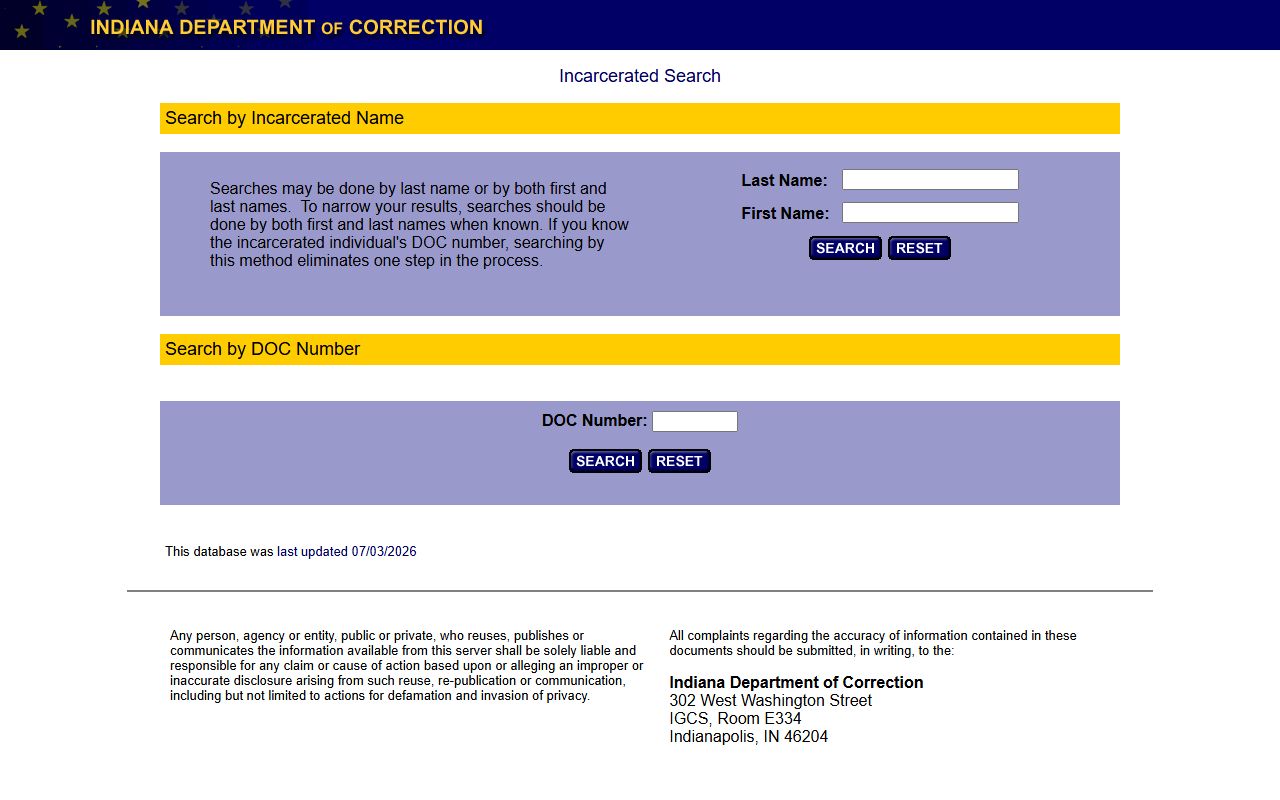
The DOC locator is a statewide sentenced-offender channel, which is separate from Scott County's booking roster and from local court charge records.
Charges Filed After Scott County Arrest
After an arrest, the prosecutor decides what formal charge, if any, should be filed. Indiana counties use a Prosecuting Attorney rather than a District Attorney, and Scott County's prosecutor is the local office that files and negotiates criminal charges for the State. The charging document starts the formal court-charge record. It can be based on police reports, probable-cause material, witness information, and legal review. One arrest can lead to one charge, several charges, amended charges, or no filed charge.
| Charging document | Who uses it | What it does |
|---|---|---|
| Complaint | Often initiated from officer or prosecutor information. | States the alleged offense and starts or supports the criminal case. |
| Information | Filed by the prosecutor. | Common formal charging document for many Indiana criminal cases. |
| Indictment | Returned through a grand jury process. | Used in some serious or grand-jury-filed criminal matters. |
Scott County Charge Status
Charge status changes as the case moves. A filed charge can be pending at initial hearing, amended during plea talks, reduced as part of a plea agreement, dismissed by court order, or resolved by trial. MyCase and the criminal court record are the best public places to confirm the formal status. Jail booking data may lag or include early arrest-related charges that are not the final court-filed charges.
| Status | What It Means |
|---|---|
| Pending | The charge is filed and has not reached final disposition. |
| Amended | The filed charge was changed by later court filing or order. |
| Reduced | The charge was changed to a lower level or lesser offense, often in a plea context. |
| Dismissed | The court record shows the charge was ended without conviction on that count. |
| Dropped / not filed | An arrest allegation did not become, or did not remain, a filed court charge. |
| Disposed | The charge reached an outcome, such as guilty, not guilty, dismissed, or other result. |
Scott County Charges vs Convictions
Being charged is not the same as being convicted. A Scott County arrest record may list an arrest-related charge from booking. A court charge record may list the formal offense filed by the prosecutor. A conviction appears only after the court record shows a guilty plea, guilty verdict, or other qualifying final result. Read the disposition and sentencing entries before treating a charge as an outcome.
| Point | Charge | Conviction |
|---|---|---|
| Record stage | Arrest allegation or filed accusation. | Resolved finding after plea, verdict, or court judgment. |
| Where it appears | Roster charge field, MyCase charge list, charging document. | Disposition, judgment, and sentencing entries. |
| Can change | Yes, it may be amended, reduced, or dismissed. | Yes, but changes usually require later court action or appeal. |
| Use caution | Does not prove guilt. | May still be sealed or expunged if eligible under Indiana law. |
Note: The sheriff roster warns that booking charges and bail may change after court appearances.
Charge Codes and Severity Levels
Scott County criminal and traffic charge entries can reference Indiana Code sections, offense descriptions, and charge levels. A criminal charge may be listed as a felony or misdemeanor, while many traffic matters are infractions unless the conduct is charged as a crime. One arrest can produce multiple charge lines, and each charge can have its own disposition. The full MyCase record is stronger than a roster entry because it ties the charge to the court, cause number, hearings, plea, and final disposition.
- Cause number
- The official Indiana court case number used to find the filed charge record.
- Disposition
- The outcome of a charge, such as guilty, dismissed, or not guilty.
- Probation
- Court-ordered supervision that may be part of a sentence.
- Expungement
- An Indiana process that limits public access to eligible arrest, charge, or conviction records.
Statewide Charge Record Channels
Statewide channels should not be confused with Scott County court charges. The Indiana DOC offender locator help page covers sentenced state-prison searches, not local pretrial custody. Indiana VINE provides custody status and notification. MyCase remains the official public trial-court case search for filed Scott County criminal charges. The sheriff's smartphone app announcement says the app includes Inmate Lookup, Jail Info, Sex Offenders, Submit A Tip, News & Events, and Community Feedback, but the research did not verify a separate app-only warrant or court-charge search.
The IDOC offender locator help source is also assigned to this page.
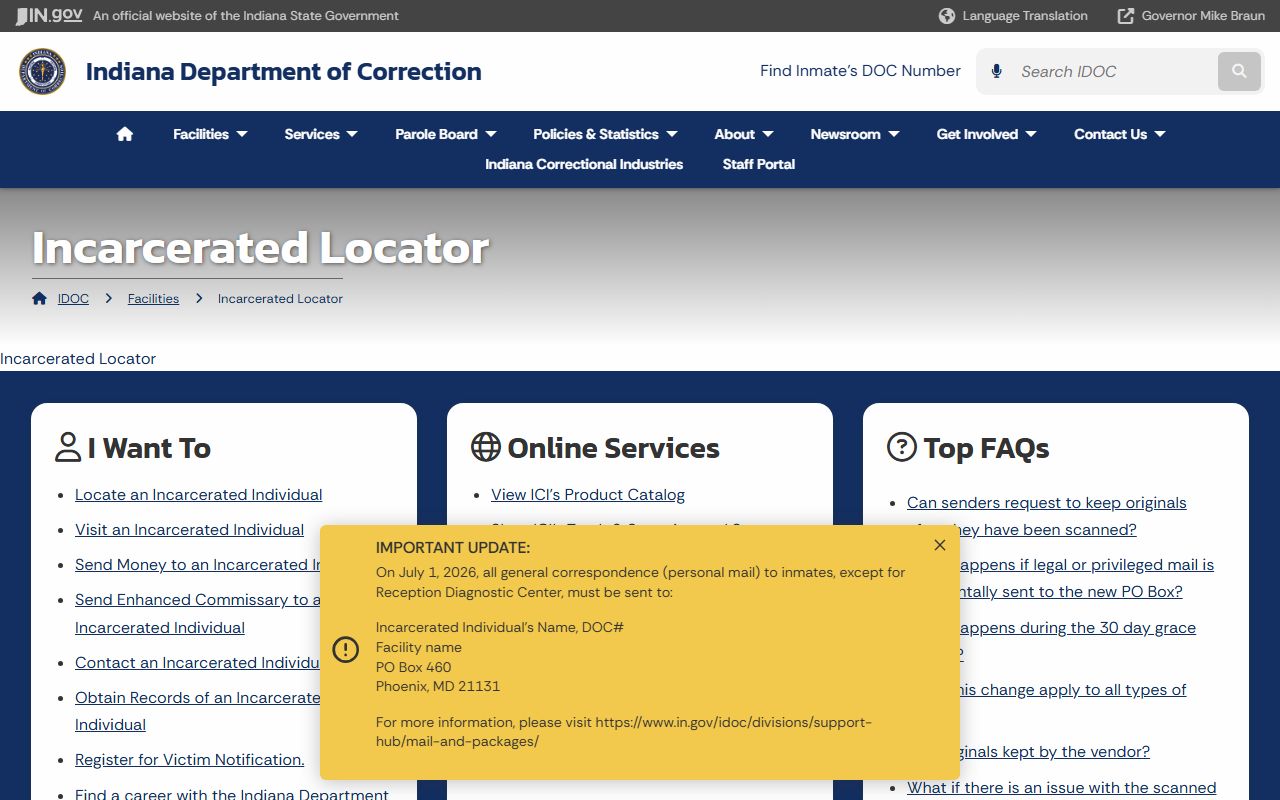
The IDOC help image reinforces the distinction between a state prison lookup, a Scott County jail booking record, and a local criminal court charge record.
Prosecutor and Public Defender
The Scott County Prosecutor's Office is at 1 E McClain Avenue, Suite 220, Scottsburg, phone 812-752-8466. The prosecutor files and negotiates criminal charges on behalf of the State. The Scott County Public Defender is at 49 E Wardell Street, Scottsburg, phone 812-752-5920. The Public Defender page says the office represents indigent individuals charged with a crime, certain DCS child-custody cases, and specific contempt matters after court appointment.
Scott County Prosecutor
Reviews allegations, files charges, handles plea negotiations, and responds to some diversion or expungement matters.
812-752-8466
Scott County Public Defender
Represents eligible defendants after appointment and can identify assigned counsel for a case.
812-752-5920
Scott County Clerk
Maintains filed case records, cause numbers, copies, certifications, and court costs.
812-752-8420
Sealed and Expunged Arrest Records
Indiana expungement under Indiana Code IC 35-38-9 can apply to eligible arrest, charge, dismissal, and conviction records. For Scott County records, the petition is filed through the local trial-court system. Eligibility is fact specific. Non-conviction arrest expungement differs from misdemeanor or felony conviction expungement, and the prosecutor may have a chance to respond. An expungement order usually limits public access rather than guaranteeing that every agency record is physically destroyed.
- Sealed
- General public view is blocked or limited because of a confidential category, court order, juvenile matter, or protected information.
- Expunged
- Public access is limited under the expungement statute and court order for an eligible arrest, charge, dismissal, or conviction record.
- Scott County filing path
- Sealing and expungement issues are handled through the trial-court system and Clerk for eligible local records.
- Limit
- Not every hidden record is expunged, and an expungement order does not erase every agency record from all systems.
Restricted Scott County Charge Records
Restricted charge records can include juvenile matters, sealed cases, expunged records, adoption-related material, mental-health or medical information, protected-party details, Social Security numbers, financial account numbers, and minor-related information. Protection orders are not searched in MyCase because protected-person identifying information is excluded from online public access. Use Indiana's protection-order and no-contact-order search for public order information where available.
Older cases, confidential filings, sealed warrants, and law-enforcement investigative records may not be available through public online search. That is not the same as no record existing. The correct fallback is to use MyCase for filed public charges, the Clerk for copies and cause numbers, the sheriff for current custody and bond, and the court for case-specific hearing questions. If counsel has been appointed, the Public Defender office can also confirm the assigned attorney for that specific criminal matter.