
Scott County Criminal Court Records
A Scott County criminal court record is the court file for a criminal prosecution in Scott Circuit Court or Scott Superior Court. The file begins after a charging document is filed and then grows as the case moves through hearings, motions, plea discussions, trial settings, disposition, and sentencing. The Scott County Clerk maintains local trial-court filings and collects court costs. The prosecutor files and negotiates charges for the State, while the public defender represents eligible indigent defendants after appointment by the court.
Scott County has two general trial courts rather than a county district court. The official court pages identify Scott Circuit Court and Scott Superior Court at the courthouse address, and the state court structure map explains that Indiana trial courts include circuit and superior courts. Misdemeanor and felony case assignment depends on local rules and court practice, but public criminal court records are searched through the same statewide MyCase path when they are not sealed, confidential, or excluded.
The Scott County Public Defender criminal case expectations source is assigned to this page.
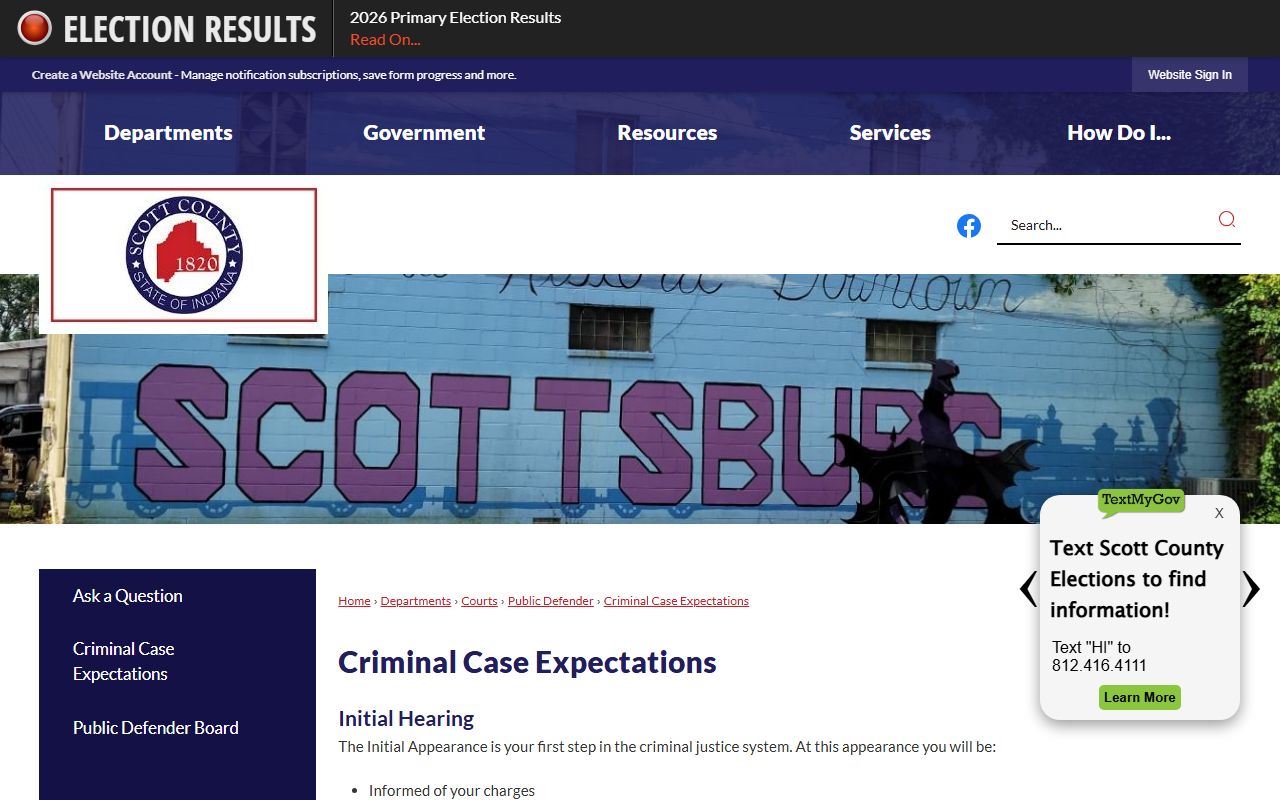
That local source is useful because it names the stages a defendant may see in a Scott County criminal case, from initial hearing through sentencing and appeal.
Search Scott County Criminal Court Records
The main public search channel is Indiana MyCase. Search by cause number when possible. If the cause number is unknown, search by defendant name and filter to Scott County. Date of birth, court, case type, and filed-date filters can help separate people with similar names. Open the case page and review the CCS for charges, hearings, plea events, disposition, sentencing, probation, and financial entries.
- Open MyCase and choose the Case or Name search path.
- Enter the cause number or defendant name, then filter to Scott County.
- Use court, case type, and date filters when a name search returns too many results.
- Open the case and read the CCS, charge list, hearings, and disposition entries.
- Contact the Scott County Clerk for certified copies or documents not available online.
Other access channels serve different needs. The Clerk handles copies and certifications at Suite 120, 1 E McClain Avenue, phone 812-752-8420. Scott Circuit Court and Scott Superior Court answer court-date questions for their assigned cases. The Scott County Prosecutor's Office can be relevant to pending charge and diversion questions, while the Scott County Public Defender handles court-appointed representation for eligible defendants. Protection orders and no-contact orders use the separate Indiana protection-order search, not MyCase.
Scott County Criminal Case Flow
Criminal court records should be read as a sequence. Scott County's Public Defender material identifies local process terms such as initial hearing, pretrial conference, plea agreement, omnibus hearing, trial, sentencing, and appeal. Each step can create a docket entry or filed document. A charge can be filed, amended, reduced, dismissed, or resolved by plea or trial. The final disposition and sentence are later entries, not the same thing as the original accusation.
Case flow: Charges Filed › Initial Hearing › Pretrial / Motions › Plea or Trial › Disposition › Sentencing
- The prosecutor files the formal criminal accusation, and the case becomes part of the court record.
- The court addresses charges, next dates, plea entry, bond, and counsel issues at the initial hearing.
- Pretrial entries may show discovery, motions, plea discussions, omnibus deadlines, and readiness.
- The case resolves by negotiated plea, bench trial, jury trial, dismissal, or other court action.
- Disposition and sentencing entries show the outcome, punishment, probation terms, fines, costs, or restitution.
Scott County Criminal Record Fields
Public criminal court records in Scott County can show both high-level case data and detailed event entries. A CCS entry may be enough to confirm a hearing date or disposition, but a certified order, plea agreement, sentencing order, or judgment may require a Clerk copy request if not linked in MyCase. For the charges themselves, including how an arrest-related allegation becomes a filed court charge, see the Scott County arrest records and charges page.
| Field | What It Shows |
|---|---|
| Cause number | The official Indiana criminal case number used for search, copy, and court contact. |
| Defendant | The person charged in the criminal case, plus public role information. |
| Court | Scott Circuit Court or Scott Superior Court. |
| Charges | Indiana Code citation, offense description, level or class, and current public charge status. |
| Hearings | Initial hearing, pretrial conference, omnibus hearing, bench trial, jury trial, sentencing, or other dates. |
| Plea | Not guilty, guilty, plea agreement filed, or other plea-related court event where public. |
| Disposition | Outcome of each charge, such as guilty, dismissed, acquitted, or other court result. |
| Sentence | Jail, prison, probation, fine, cost, restitution, no-contact term, or other sentence information when public. |
| Financials | Court costs, fines, payment entries, and balances where visible. |
Scott County Charges vs Convictions
A charge is an accusation filed in court. A conviction is the result after a guilty plea, guilty verdict, or other qualifying finding. Scott County criminal court records can show charges that did not end in conviction because a charge may be dismissed, amended, reduced, or resolved differently than first filed. Do not treat a charge list as a conviction list without reading the disposition entries.
| Point | Charge | Conviction |
|---|---|---|
| Stage | Accusation after filing. | Final or resolved finding after plea or trial. |
| Record location | Charge list and early CCS entries. | Disposition, judgment, and sentencing entries. |
| Meaning | The State alleges the offense. | The court record shows guilt was established or admitted. |
| Common change | May be amended, reduced, dismissed, or dropped. | May lead to sentencing, probation, fines, and costs. |
The Scott County Prosecutor's Office source is assigned to the criminal records page.
The prosecutor source anchors the local role of the office that files and negotiates criminal charges for the State of Indiana in Scott County.
Read Dispositions and Sentences
Disposition is the outcome of a charge, claim, or case. In a Scott County criminal record, read the charge list and then the disposition entry tied to each charge. One case may have several charges with different outcomes. A defendant may plead guilty to one count while another count is dismissed. Sentencing entries should be read after disposition entries because the sentence explains punishment and conditions after a conviction.
Common record terms include initial hearing, pretrial conference, omnibus hearing, bench trial, jury trial, plea agreement, sentencing, probation, bond, warrant, and expungement. Probation is court-ordered supervision instead of, or after, jail or prison. A bench trial is decided by a judge. A jury trial is decided by jurors. A dismissal is not the same as a conviction, but the record may remain public unless sealed or expunged.
Note: Jail roster charges and bail warnings may change after court appearances, so confirm court outcomes in the criminal case record.
Sealed and Expunged Records
Indiana allows eligible criminal, arrest, and conviction records to be sealed or expunged under Indiana Code IC 35-38-9. For a Scott County criminal case, the petition is filed in the local trial-court system through the Clerk. Eligibility depends on the record type, disposition, conviction level, waiting period, and prior expungement history. The prosecutor may have a chance to respond before the judge decides.
| Point | Sealed | Expunged |
|---|---|---|
| Public visibility | Hidden or limited from general public access by order or rule. | Public access is limited under Indiana expungement law and the court order. |
| Record existence | The record still exists but is not generally public. | Indiana expungement often limits disclosure rather than destroying every agency record. |
| Local filing | Handled through the court case where the restriction is ordered. | Filed in Scott County trial court for eligible local cases. |
| Examples | Juvenile, adoption, protected, medical, or court-sealed information. | Eligible arrest, charge, dismissal, or conviction records under IC 35-38-9. |
The Indiana Code Title 35 source image is assigned to this page because it includes criminal law and expungement authority.
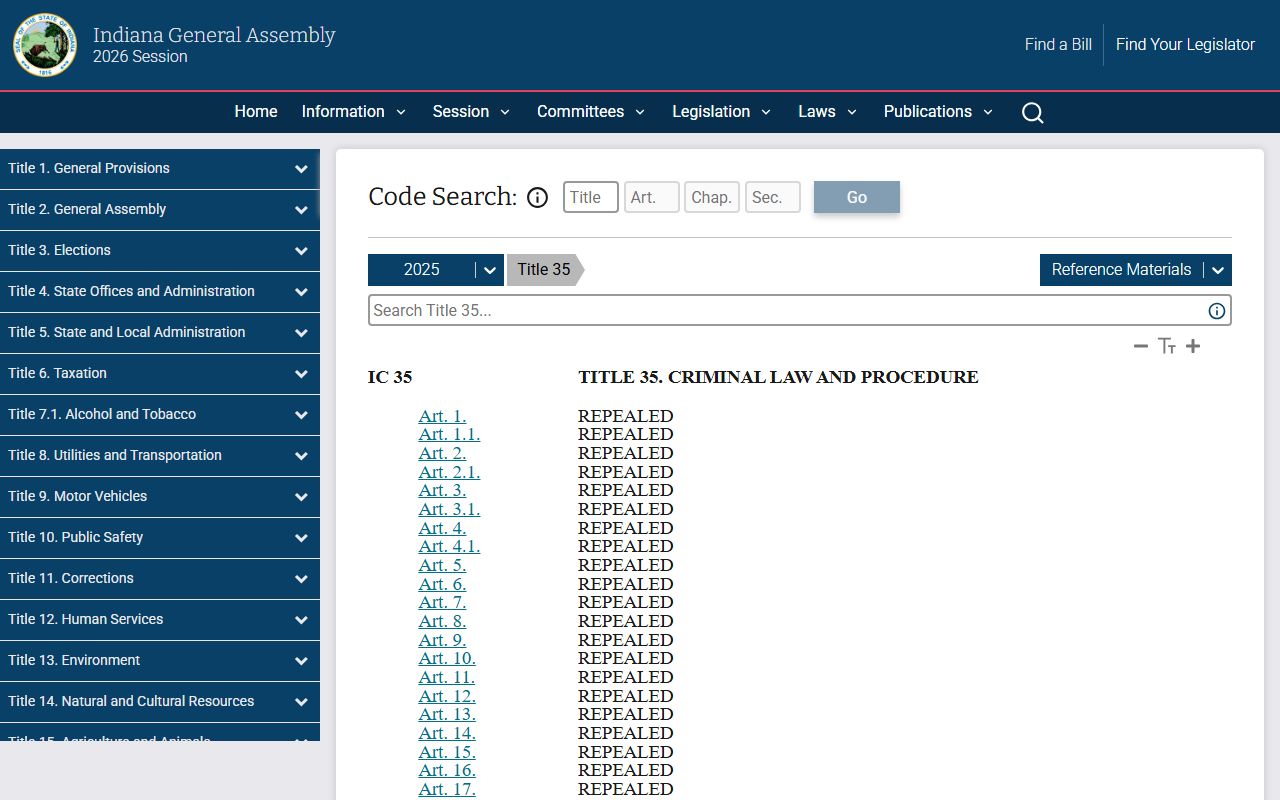
Title 35 supports the expungement discussion and the criminal-law citations that may appear in public charge entries.
Public Access to Scott County Criminal Records
Public access starts with Indiana Access to Court Records Rule 4, which states that court records are public unless excluded by Rule 5 or another authority. Rule 5 excludes many confidential categories. Juvenile records are also governed by Indiana juvenile statutes, including authority in Indiana Code Title 31. A missing online criminal record may be sealed, expunged, juvenile, older, not yet indexed, or simply not available as a downloadable document.
Key access rules:
Access to Court Records Rule 4 states the public-access baseline for Indiana court records.
Access to Court Records Rule 5 lists case records and administrative records excluded from public access.
The Scott County Public Defender source is assigned to this criminal-records page.
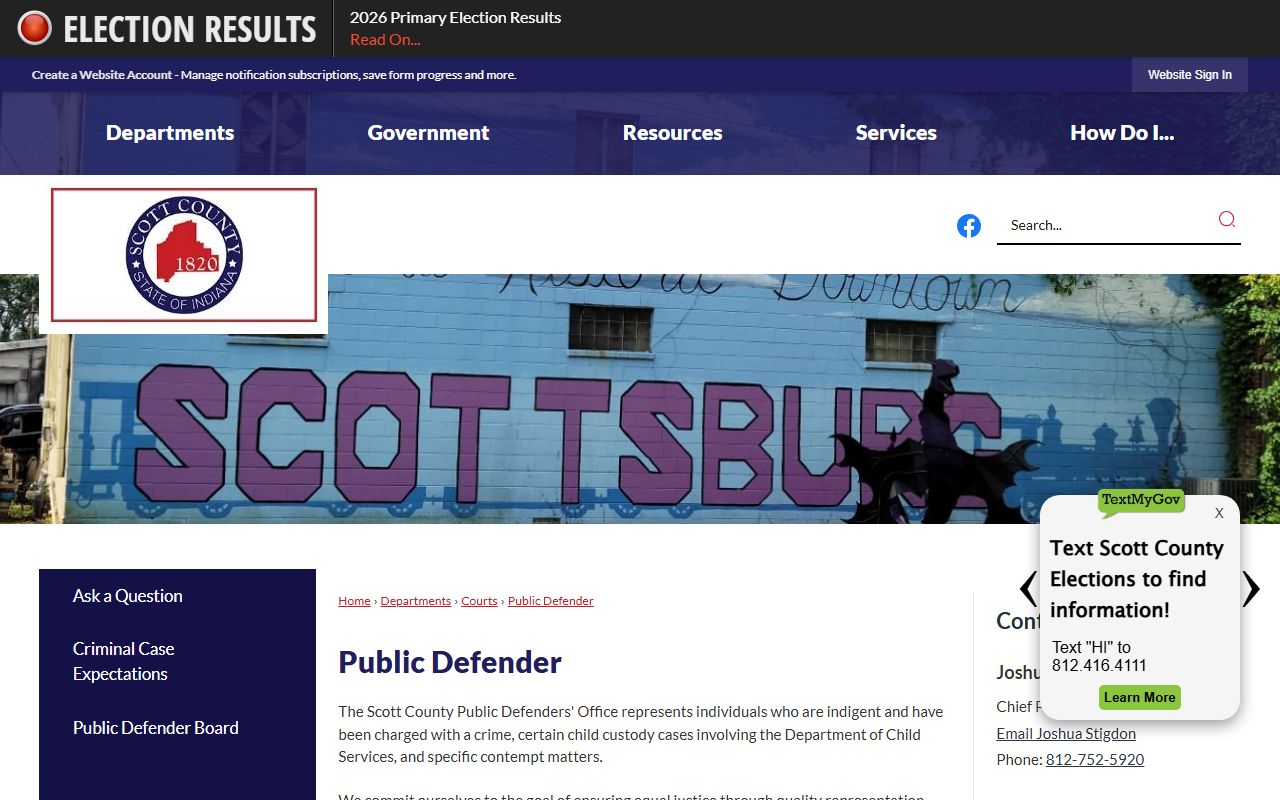
The public defender source adds local context for appointed counsel, eligibility, assignment timing, and the limits of representation in criminal cases.
Federal Criminal Records Difference
Scott County criminal court records are local Indiana trial-court records. Federal criminal cases are not kept by the Scott County Clerk. Scott County is in the Southern District of Indiana, and the New Albany federal courthouse serves Scott County for federal court location purposes. Federal criminal cases use federal court systems and PACER, while state cases use MyCase and the local Clerk. A person can have both state and federal records if different agencies filed different cases.
The U.S. Attorney's Office for the Southern District of Indiana source is assigned to this page.
The U.S. Attorney source marks the federal prosecution channel, which is separate from Scott County Prosecutor filings in local trial court.
Restricted Scott County Criminal Records
Restricted criminal court records include juvenile matters, sealed records, expunged records, protected-party identifiers, confidential mental-health or medical information, Social Security numbers, financial account numbers, and certain records involving minors. Adoption and some family-related material can also be confidential even when a case has a public fee category. If a case involves a protection order or no-contact order, the separate protection-order registry may show public order information that MyCase does not show.
For copies, the Clerk's posted fees are $1 per page, $2 per certification, and $1 per page for a Chronological Case Summary. Abstractors must come into the office, and the Clerk does not take abstractor requests by phone or email. The court, not a public search result, controls whether excluded or sealed material may be inspected.